
We are proud to say that we celebrate all forms of simulation that relate to flight or aviation in some way. For a while now, we have covered Tower Simulator, from FeelThere, because it has grown into a platform that has gone from strength to strength. Be it because of fresh updates that enhanced the visuals and added new airports, or simply because of more and more community engagement.
What this growth has lead to is a new wave of content provided by third-party add-on developers such as FlyTampa and Just Flight. Last year, we saw FlyTampa bring its Sydney Airport to the platform, and more recently, Just Flight brought its new traffic pack to the ATC simulator. This is a signal that others are seeing potential in the stand-alone simulator (you don’t need Microsoft Flight Simulator or X-Plane) as a new source of user engagement. We’re proud to say we’ve been bringing Tower Simulator to our audience for a long time now, and even more proud to have the ability to be able to speak directly to the team behind the simulator.
In this interview, we spoke to Vic, founder of FeelThere and Robbie, Lead Developer at FeelThere, about the platform, the new relationships being established, and what future add-ons we could see from the team to further enhance Tower Simulator.
1 – Intro: Please give us a little more information on yourself and your involvement with Tower for FeelThere.
Vic: I founded FeelThere 24 years ago with the vision of creating add-ons that felt “worn” and “used”, a departure from the typical add-ons available at the time. The name “FeelThere” directly reflects that original goal.
I am responsible for the long-term vision at FeelThere, while Robbie manages the daily execution and guidance of the rest of the team. I also play the guitar, and I’d say I’m pretty decent at it!
2 – Previous add-on content for Tower focused on adding new airports for people to control at. Why was a traffic add-on needed for Tower?
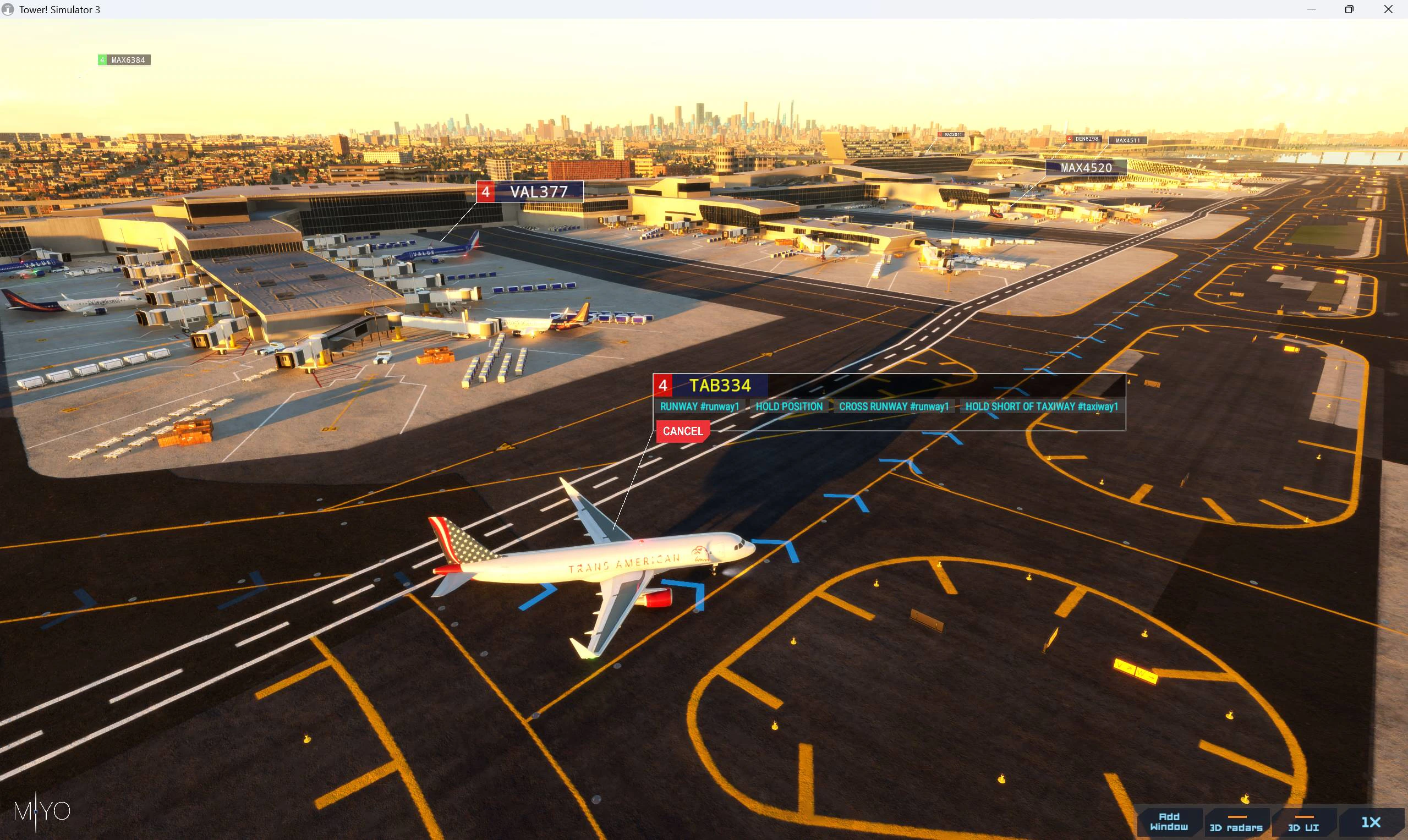
Robbie: We wanted to improve our airplane model quality for the game and have players enjoy the experience more. The new models include real callsigns and have over 900 liveries.
Additionally, it works with almost any airport right out of the box, whether it’s made by the community or an existing developer. Traffic for Tower Simulator 3 includes a global schedule and data for nearly 4,000 airports, so it’s likely that even if someone develops a small airport, there won’t be a need to create a custom schedule to make it work.
Vic: Our goal for Tower Simulator is to establish it as a new platform for developers. We aim to attract more developers to join the existing companies already utilising Tower. This expansion is intended to broaden the selection of available add-ons, offering the community a greater variety of choices.
3 – This is a Just Flight product, but what additional support and involvement did FeelThere have in making this a reality?
Robbie: FeelThere offers an Airplane Exporter SDK, which is available to the public for free, to export airplanes using Unity and make them compatible with Tower Sim 3.
The Airplane SDK allows anybody to model and export an airplane for the game. This was used exclusively to export the models provided by Just Flight.
Vic: We are committed to supporting all reasonable efforts to create new add-ons for Tower Simulator, including commercial developers and community-driven freeware projects. If a developer has a viable idea, we are ready to assist them with connections or improvements for Tower Simulator.
4 – Who approached whom for bringing Traffic to Tower?
Robbie: I’m sure Vic, the President of FeelThere, had a role in it and has a history of collaborations with Just Flight on previous flight sim-related products. It really was a group effort, with members of Just Flight and FeelThere working together to make this a reality.
Vic: The long-standing relationship between Just Flight and FeelThere, spanning over 20 years, has always featured open communication. Therefore, combining our efforts to integrate the Just Flight Traffic line into Tower Simulator was a natural and logical progression.
5 – In terms of the product itself, care to tell us how it will enhance the user’s experience?
Robbie: The base game does not include real airline names or liveries, so this is another way for players to create a more realistic scenario. In addition to this, the 3D models are vastly updated compared to the planes included with the game. They have better textures, more detail, and more geometry.
6 – How about performance? How was this monitored to ensure it’s not going to heavily impact the user’s system?
Robbie: The airplanes use LODs, or levels of detail, that are more optimised than before. As the player camera moves away from an object, the quality of each model will drop without the player noticing any difference, which results in higher performance. Even large airports with busy custom schedules will see an improvement when using these models.
7 – Just Flight is now selling FeelThere add-ons. Is this the start of a larger collaborative approach?
Robbie: I believe it is, since we have been partners in the past with previous products. However, this is a first for Just Flight selling Tower Simulator 3 and its related add-ons. Our goal with this collaboration is to expand the Tower Sim community for those who are looking to try something different while still relating to flight sim.
At the same time, this is not only for flight simmers. Tower Sim is used by a wide variety of people, some of whom use this as a memory-style game where you need to control different scenarios or patterns to avoid errors and keep traffic running smoothly.
8 – Tower has really started to expand with new third-party developers bringing their products to the sim. Are there future collaborations we can expect?
Robbie: Yes, though I’m not sure if I can say who just yet. We can expect some airports from well-known developers in the coming months from Canada and Australia, and likely more afterwards.
We encourage any flight sim developer to reach out to us if they’re interested in converting their existing airport models from flight sim to Tower Sim 3 and expanding our catalogue.
Vic: Given the high level of development and existing products for other simulators, we see a significant opportunity for developers to either port their existing products or create entirely new ones for Tower Simulator. The increasing number of partners joining us is a testament to this potential. We actively welcome all developers and are committed to supporting their creative ideas.
9 – Why would someone with MSFS or X-Plane who uses an online network want to consider Tower?
Robbie: Tower Sim 3 allows you to learn Air Traffic Control at your own pace and to make mistakes. Some flight sim users might not want to try a live ATC add-on if they’re not confident in their skills or are unsure of what to say. Tower Sim allows them to learn by starting at a small airport and working their way up to controlling a large international airport with a busy schedule.
It’s also available for multiplayer, so you could control, for example, the ground at one part of an airport while another player controls arrivals.
Vic: Tower Simulator places you in the role of an Air Traffic Controller. The program is designed to let you learn at your own pace, progressively using more features as you gain experience. You can begin at a small general aviation airport with a single runway and advance to increasingly busy airports. As your confidence develops, you can even participate in large multiplayer sessions with multiple online users.
10 – Can you tell us anything about the future of Tower and what we can expect in future updates?
Robbie: We are always working on improving the gameplay based on community feedback and adding new features to the game. Every few months, we publish a large update and include another free airport. I can’t say exactly what is next just yet, but there are a few things we’re currently working on that will greatly improve the experience for a more realistic simulation.
Vic: Maintaining a fresh and current platform is our primary goal and responsibility. We have a dedicated team overseeing the long-term development of the core simulator, along with another group focused on content creation, such as airports. We are proud to have nearly met our ambitious goal of releasing two new airports per month, now offering over 50 add-on airports in addition to the 11 free ones included with the simulator.
Our long-term commitment is to enhance and further develop the core simulator and, after more than 15 years of developing air traffic simulators for the community, establish ourselves as the industry standard. We plan to continue the Tower Simulator franchise for many years, actively supporting our community.
We consider ourselves fortunate to have such a large and dedicated following. Unlike other forums that often experience growing problems, our community is consistently kind, intelligent, creative, and supportive.


