
Strap in those shoulder harnesses and reach for that gear lever, because the iFly 737 MAX8 is on final approach, and we at FSElite are lucky enough to have been given a sneak preview ahead of its release.
I find myself in a unique position in that this is an aircraft I fly on a day-to-day basis in real life, so my anticipation for the iFly 737 MAX8 has been huge, as it also has been by the wider flight simulation community.
[Editors Note: I really wanted to put REAL WORLD PILOT in the title, but Jordan didn’t let me! -CM]
As ever, we must stress that this is not the final version, tweaks will still be made prior to its general release, but one thing is for sure… it’s almost here. As such, this is more of a first-look article than a full in-depth review.

So without further ado, let’s climb aboard and take a look…
There’s no denying that the iFly 737 MAX8 certainly looks the part. If it weren’t for the blue and white of United paint on the side, nor the fact we’re in Edinburgh Airport (ICAO: EGPH) (I know… immersion ruined!), I would think I was about to start another day at work.
A quick stroll through the cabin demonstrates the usable flight attendant panel (FAP), overhead bins that can be opened and closed and for some simmers the most important detail of all; the toilet! (Let’s just be glad we can’t simulate smells in the sim, eh?)


And now to the pointy end, for our short flight down to Manchester (ICAO: EGCC) and once again, I’m sorry to those die-hard immersion lovers.
There is certainly no denying this is a MAX, with its enormous glass instrumentation screens and… well, very little change from the older 737s. The overhead panel is still as cluttered as ever, the flightdeck still feels as small as though you were wearing a backpack with wings. As a REAL WORLD PILOT, I like what I see. [Editor’s Note: Yes, I snuck it in. -CM]

The iFly 737 MAX8 comes with its own EFB. Inside, users will find a multitude of customisable options, from engine variants, autopilot logic and other options such as selecting the Wi-Fi antenna on the top of the aircraft, or airstairs. SimBrief is also implemented, requiring a Navigraph account. Further additions will be added in later versions, including the MAX 8-200 which Ryanair uses.


Let’s power her up. No ground power unit in Edinburgh today means it’s straight onto the APU, which from the outside sounds amazing. Those with a keen eye will notice the MAX8 comes with a different-looking APU door on the side of the fuselage, and the overhead panel in the flight deck is now missing the APU exhaust temperature gauge.

The cockpit preparations get underway, our route is uplinked into the FMC and the onboard performance calculator gives us our takeoff speeds. We’re good to go!
A quick change of time in the simulator enables us to have a look at some of the lighting on the aircraft, with the MAX8 utilising LED lights in reality. They look sharp.


As we start pushing back, the ground crew give us the all-clear to start the engines. Simmers, beware, in reality, each engine can take nearly three minutes to start up, especially when they’re hot. So be patient and prepare for a deluge of ‘are you nearly ready for taxi?’ questions from ATC. The introduction of bowed rotor motoring has significantly increased this part of the journey, and an additional three minutes needed to stabilise the engines once they’ve started means patience is required.

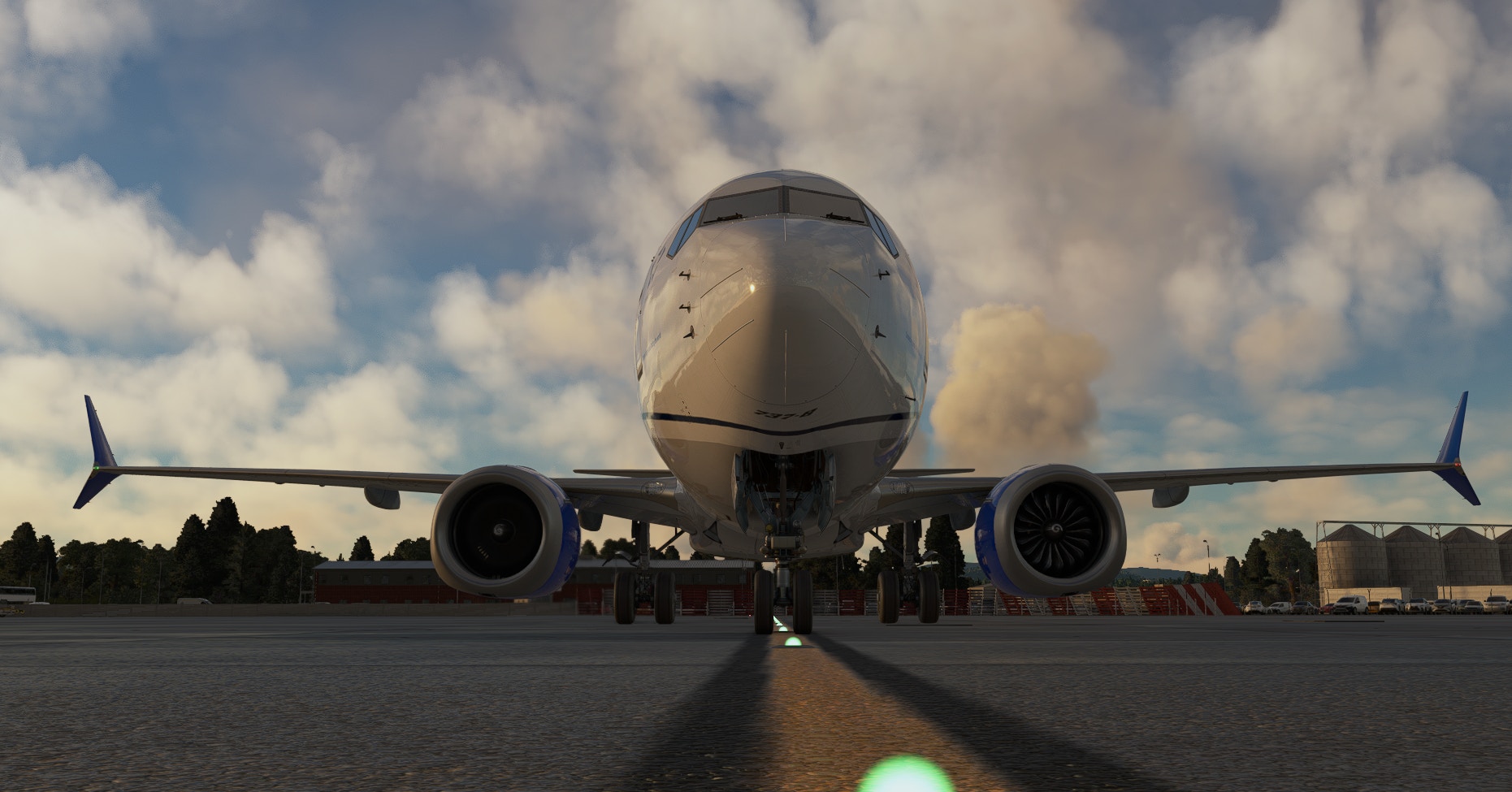
There’s no denying the likeliness of these engine sounds to reality… I almost forgot I was flying a computer and not the real thing!
We set our flaps to 5, flick the taxi light to on, and head out to runway 24 in Edinburgh, the enormous and sleek-looking winglets that set the MAX apart from the 737 NGs glistening in the sunlight.

Before we know it, the thrust levers are up to 40%, and after a momentary delay, we push TOGA and away we go. The LEAP1-B engines have always been a beastly powerplant, and it shows too in the sim. With a gentle rotation of approximately 2-3 degrees per second, we take to the skies on our maiden voyage heading southbound.


Today we departed in VNAV, and the aircraft’s complex navigation systems kick in as we started to retract the flaps and accelerate away.
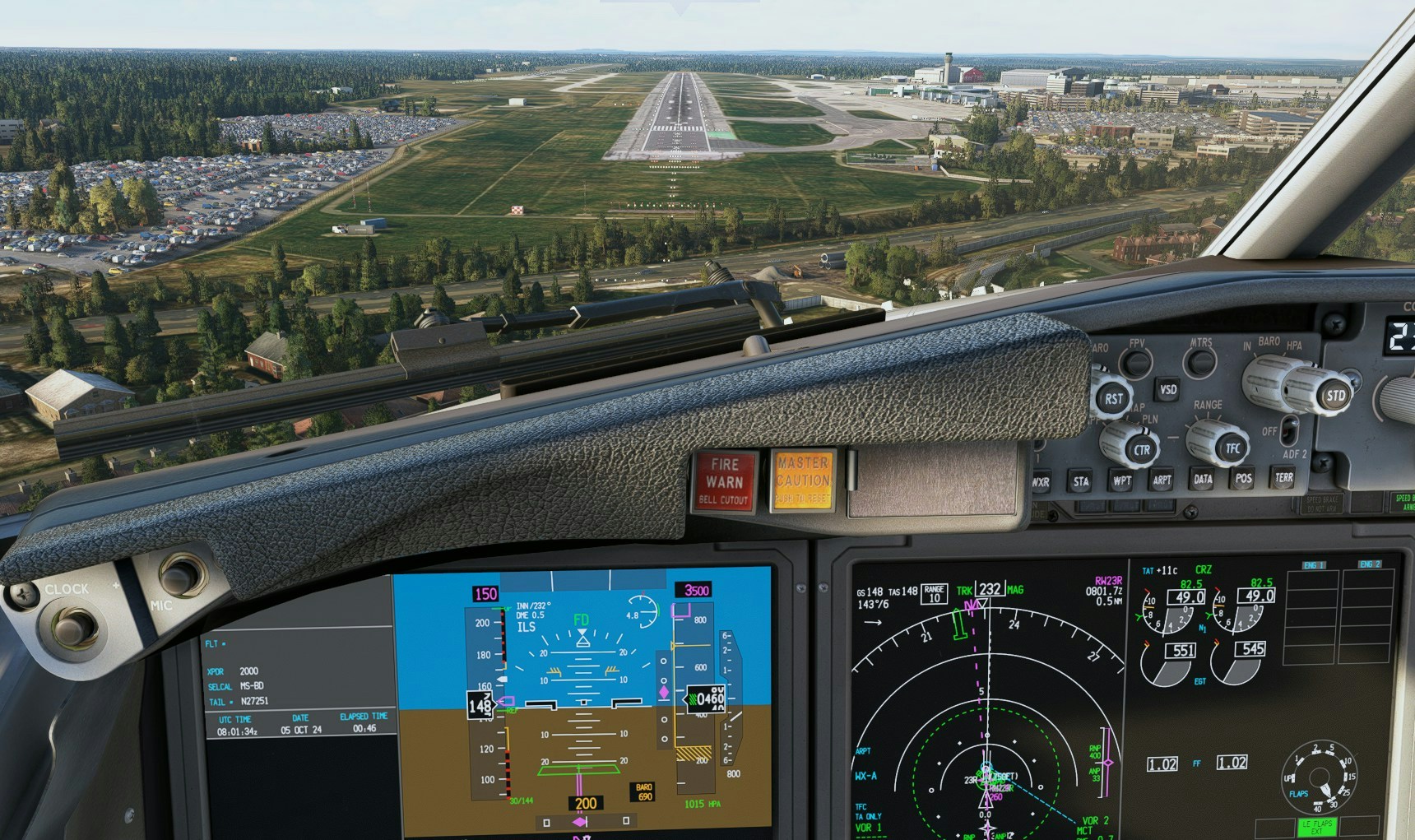
As soon as are we up in the skies, it is already time to consider coming back down again. We’ve planned for the VOR approach to Manchester’s 23R today and will use the 737’s IAN capability (Integrated Approach Navigation), which for all intents and purposes shows up on the PFD with the same indications as an ILS despite us flying a non-precision approach. Easy, huh?


A quick lap or two around the hold and we’re ready to make the approach. After intercepting the inbound course from the north, we drop the gear and start slowing down and preparing for landing. Perhaps now would be a good time to highlight the VOR approach into Manchester is offset from the runway… it’s not my dodgy flying, though that will certainly materialise at some other point I’m sure!


With a bucket load of luck, we kiss the tarmac in Manchester and after a use of idle reverse thrust, begin to decelerate and slow to a walking pace to vacate the runway. Our maiden voyage is now complete! The sounds touching down are great, and you can hear the brakes kicking in as you slow down.


The APU is started again on the taxi towards the stand, and after shutting down one engine before approaching the gate to do our bit for the virtual environment within Microsoft Flight Simulator, we set the parking brake and power her down.


There’s no denying this is an exciting product and with further enhancements to come, I for one am beyond excited to see the finished product. iFly says there is much more to come in the future, including cabin announcements, the 737 MAX 8-200 variant and alternative cabin layouts.
Some of us at FSElite will be flying her around a fair bit between now and release, so we’ll be sure to share even more content on the iFly 737MAX with you as we put it through its paces. This includes a full in-depth review of the plane, interviews with the developers, and video content.
Simmers can get involved and follow the progress directly in their Discord server, but be sure to stay tuned to FSElite for further updates on the iFly 737 MAX8’s progress.


